Sale Analysis
Sale Analysis — the report provides information on the results of processing sold goods. If the product in question from the request is linked to a set assembly ("complectation"), then its ingredients from the expense part of the set assembly are included in the report. For each sold product, purchase and sales amounts excluding and including tax (e/t and i/t) are displayed, as well as markup. For goods linked to set assemblies, sales amounts and taxes are distributed among the ingredients proportionally to their cost from the expense part of the set assembly. The report is generated based on Requests and the delivery notes associated with them.
Sale Analysis - Filter
The view of the filter for the Sale Analysis report:
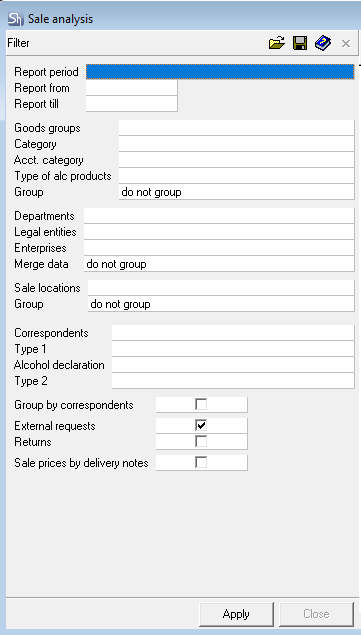
The filter parameters "Report from ... to...", "Departments", "Legal Entities", "Enterprises", "Correspondents" are filled in using standard methods.
Additional filter fields:
Sale locations – in this field, you can select the points of sale whose requests will be used to generate the report.
Group By – if necessary, select the method for grouping the report data output in this field: Do Not Group or By Sale locations.
Group by Correspondents – check this box if you want the data in the report to be grouped by correspondents.
External Requests/Returns – use the flags to define for which type of requests the report should be generated. Setting one of the flags is mandatory.
Sale prices by delivery notes – when this flag is set, sales amounts will be taken from the expense/receipt delivery notes created based on the requests, not from the requests themselves. This may lead to discrepancies between the data in the requests and the report if "write-off at cost" or "write-off with a cost coefficient" was used.
After filling out the filter, to generate the sales analysis, click the Apply button.
Sale Analysis - Content
The Sale Analysis report table with all groupings:

Groupings on the left:
Group – the selected grouping method in the filter based on your organization's details (Department or Enterprise or Legal Entity).
Sale locations – if the "by sale locations" grouping is set in the filter.
Correspondent – if the "by correspondents" grouping is set in the filter.
Table fields:
Goods – this field displays the name of the goods item/service.
UOM – contains the name of the product's unit of measurement for which the Report flag was set in the product card on the Units of Measurement tab.
Quantity – this field displays the quantity of the sold goods item/service.
Purchase Amounts – the following values are displayed in this section of the table header:
Price – purchase price of the goods;
Sum e/t – purchase amount excluding taxes;
VAT – purchase value-added tax;
Sales Tax – purchase sales tax;
Sum i/t – purchase amount including taxes.
Sale Amounts – the following values are displayed in this section of the table header:
Price – sales price of the goods;
Sum e/t – sales amount excluding taxes;
VAT – sales value-added tax;
Sales Tax – sales sales tax;
Sum i/t – sales amount including taxes.
Markup – the following values are displayed in this section of the table header:
Markup e/t – markup amount on the purchase price excluding taxes;
Markup i/t – markup amount on the purchase price including taxes;
% e/t – markup percentage on the purchase price excluding taxes;
% i/t – markup percentage on the purchase price including taxes;
(Pur/Sale)% e/t – ratio of purchase and sales prices as a percentage excluding taxes;
(Pur/Sale)% i/t – ratio of purchase and sales prices as a percentage including taxes.
Returns in the "Sales Analysis" are displayed with negative values, as these amounts must be subtracted from the sales amount.
If both sales and returns fall under the specified filter, the report will display the sum (taking into account the sign) for each product.