Step Bill of Sale
The Step Bill of Sale ("Пошаговый акт реализации") report provides information on the results of processing sold goods and services, with the ability to break down the report generation period into intervals (repeating periods). For each sold item, purchase and sales amounts excluding and including tax (e/t and i/t) are displayed, as well as markup and FoodCost. The report is generated based on Requests. The report allows you to generate sales and return statistics for dishes (menu items), determine the profitability of individual product groups, or analyze the entire menu.
Step Bill of Sale - Filter
The filter for the Step Bill of Sale report:
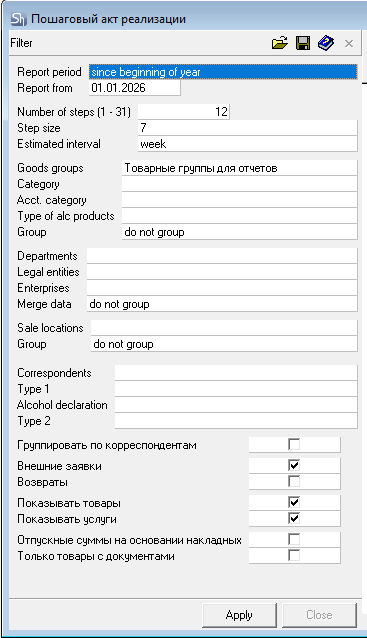
The filter parameters "Report from ...", "Departments", "Legal Entities", "Enterprises", "Product Groups", "Category", "Accounting Category", "Type of Alc Products", "Correspondents", "Correspondent Attributes", "Report Currency" are filled in using standard methods.
Number of steps (1-31) – how many intervals from the start date ("Report from...") to analyze for report generation; enter a numerical value from 1 to 31.
Step Size – determines the frequency (distance) of intervals – week, month, quarter, year; a numerical value can also be specified.
Estimated Interval (Calculation Interval) – how many days (specified manually as a number of days) from each interval to analyze for report generation, or you can select an interval from the drop-down list: week, month, quarter, year.
The fields "Report from...", "Number of Steps (1-31)", "Step Size", "Calculation ("Estimated") Interval" determine how to build the array of intervals for the report.
If the Step Size is less than the Calculation ("Estimated") Interval value, the report's interval size and step will be equal to the value from the Step Size field.
Example of Defining Intervals from the Filter:
It is necessary to conduct an analysis from 01/01/2022, use delivery note data for 6 months ahead, and analyze the first 3 days of each step.
To solve this task, specify in the filter:
Number of Steps - 6 (number of months forward from the report start date);
Step Size — select month;
Estimated (Calculation) Interval - 3 (number of days in the interval).
Thus, we get an array of intervals for building the report.
01.01.2022-03.01.2022
01.02.2022-03.02.2022
01.03.2022-03.03.2022
01.04.2022-03.04.2022
01.05.2022-03.05.2022
01.06.2022-03.06.2022
Analysis by Specific Days of the Week
If it is necessary to conduct an analysis for specific days of the week, then in Step Size you need to select "week", and in Estimated (Calculation) Interval the number of days, not more than 7.
For example, need to analyze Saturdays and Sundays for January 2022.
Filter filling:
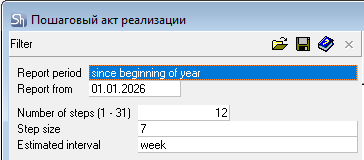
where "Report from..." — the first Saturday of the month, Number of Steps — number of weekends in the month, Step Size — step to analyze, Calculation Interval — number of days in the step. Report interval array for:
01.01.2022(Sat)-02.01.2022(Sun);
08.01.2022(Sat)-09.01.2022(Sun);
15.01.2022(Sat)-16.01.2022(Sun);
22.01.2022(Sat)-23.01.2022(Sun);
29.01.2022(Sat)-30.01.2022(Sun).
Additional Filter Fields
Sale locations – in this field, you can select the points of sale whose requests will be used to generate the report.
Group By – if necessary, select the method for grouping the report data output in this field: Do Not Group or By Sale locations.
Group by Correspondents – check this box if you want the data in the report to be grouped by correspondents.
External Requests/Returns – use the flags to define for which type of requests the report should be generated. Setting one of the flags is mandatory.
Show Goods/Show Services – use the flags to define which type of goods should be displayed in the report. Setting one of the flags is mandatory.
Sale prices by delivery notes – when this flag is set, sales amounts will be taken from the expenditure/receipt delivery notes created based on the requests, not from the requests themselves. This may lead to discrepancies between the data in the requests and the report if "write-off at cost" or "write-off with a cost coefficient" was used.
Only Goods with Documents – when this flag is set, the report will only include those goods for which "closing delivery notes" have been created in the requests. For external requests – an expense delivery note or a receipt payment document (for services). For returns – a receipt delivery note or an expense payment document (for services).
Before generating the report, it is possible to configure the table without breaking it down into intervals, because after generating the report, changing the table part will be available for each interval, which will complicate configuration:
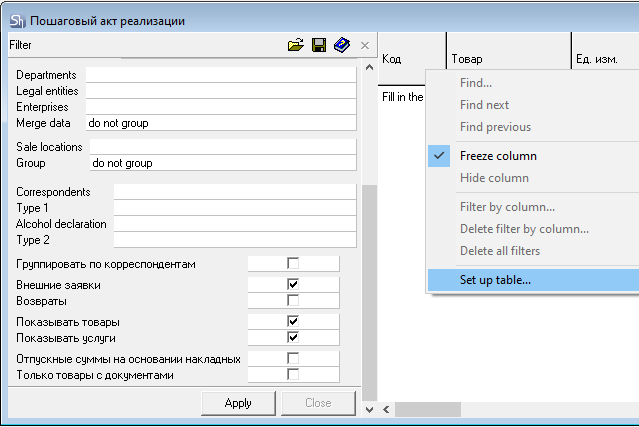
- Fill out the filter and before clicking the Apply button, focus the mouse on the table part of the report and call the context menu "Table Settings".
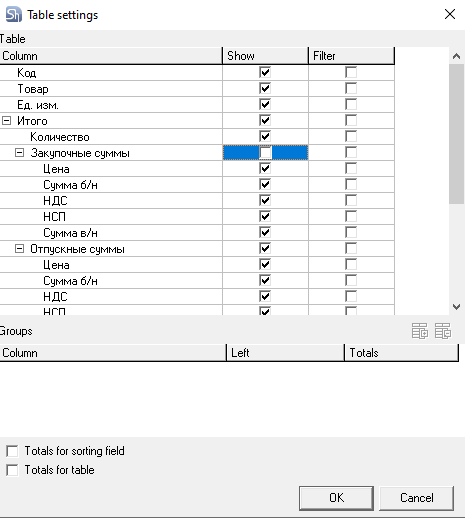
- In the window that opens, uncheck or check the boxes for the necessary report fields, and if necessary, set the flags for configuring Totals in the lower part of the window.
After filling out the filter and configuring the table, to generate the step bill of sale, click the Apply button.
Step Bill of Sale - Content
The table of the Step Bill of Sale report is shown in the screenshots:
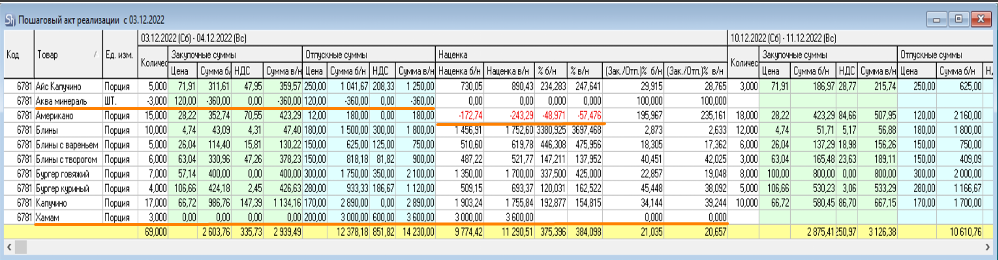
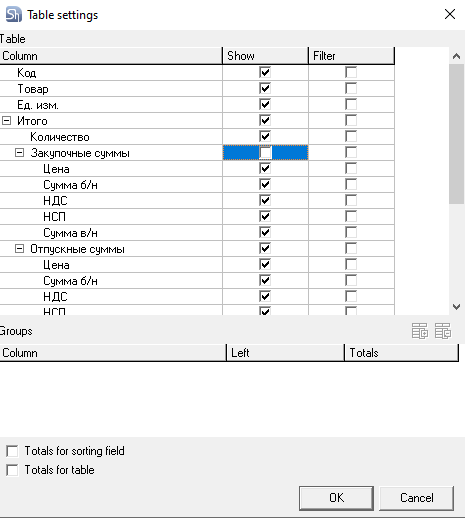 image2023-2-15_13-32-51.png" height="250"/>
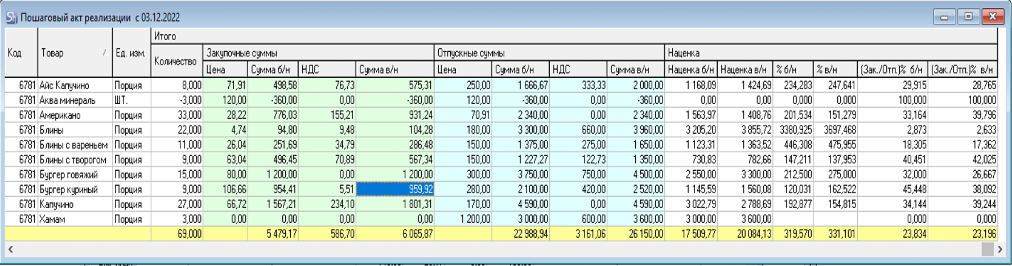
Table fields:
Goods – this field displays the name of the goods/service.
UOM – contains the name of the goods item's unit of measurement for which the Report flag was set in the product card on the Units of Measurement tab.
Quantity – this field displays the quantity of the sold goods/service.
Purchase Amounts – the following values are displayed in this section of the table header:
Price – purchase price of the goods;
Sum e/t – purchase amount excluding taxes;
Sum i/t – purchase amount including taxes.
Sale Amounts – the following values are displayed in this section of the table header:
Price – sales price of the goods;
Sum e/t – sales amount excluding taxes;
VAT – sales value-added tax;
Sales Tax – sales sales tax;
Sum i/t – sales amount including taxes.
Markup – the following values are displayed in this section of the table header:
Markup e/t – markup amount on the purchase price excluding taxes;
Markup i/t – markup amount on the purchase price including taxes.
Negative markup is highlighted in red.
% e/t – markup percentage on the purchase price excluding taxes;
% i/t – markup percentage on the purchase price including taxes;
(Pur/Sale)% e/t – ratio of purchase and sales prices as a percentage excluding taxes;
(Pur/Sale)% i/t – ratio of purchase and sales prices as a percentage including taxes.
Returns in the "Bill of Sale" are displayed with negative values, as these amounts must be subtracted from the sales amount.
If both sales and returns fall under the specified filter, the report will display the sum (taking into account the sign) for each product.
If the filter specifies the display of services, these items will appear in the report with purchase amounts equal to 0.